The Bedouin evening and the stars: what you are actually buying in the Sinai desert
8 min read
Every hotel desk in Sharm El Sheikh sells the desert evening, and almost everyone books it as “the quad tour with dinner”. That description gets the proportions backwards. On the eight-hour trip the quad is one part of four — by the operator’s own timings the riding itself takes under an hour — and the hours after dark are the reason to book the long version.
This article is about those hours after dark. The riding half — the second-seat rule, the weight limit, the age gap, what to wear — is worked through in the quad safari and is not repeated here.
Eight hours, in the operator’s own breakdown
The itinerary on the Super Safari runs: half an hour in the van, four hours of camp activities including the quad ride and the off-road section, two hours of dinner and a traditional dance show, half an hour back. That comes to seven, while the listing gives the complete experience as approximately eight hours — so treat the blocks as approximate and plan on a late return.
So you are buying: about half the trip at the safari centre and the camp, around two hours of dinner and show, and about an hour in total in the van. If the desert itself is what you want, this shape is right. If the quad is what you want, book a short quad ride instead and you are home by dinner.
Whose desert this is
The camps sit in Muzeina country. The Mzeina — also written Muzeina — are the largest Bedouin group in Sinai, and Dahab, up the coast from here, holds one of their largest populations. Mzeina Bedouin By Sinai standards they are a late arrival: a survey of the peninsula’s tribes places the Muzaynah in the late 15th century, well after the Beni Wasil, the Sawalhah and the Hamayda. The one tribe here that does not trace its origin to Arabia at all is the Jebeleya, around St Catherine, sent to the high mountains in the 6th century from Wallachia and Alexandria to serve the monastery. Sinai Bedouin tribes
That is worth knowing for one practical reason: “Bedouin” on a booking page is not a style, it is a set of people whose territory you are driving into. The tea, the bread and the camp are theirs. What follows is not.
The show is entertainment, and that is fine
The listings are honest about the evening programme if you read the nouns. One calls it “traditional Oriental entertainment shows”. Another names “belly dancing and fire shows”. A third advertises “live shows”.
Belly dance and fire spinning are not Sinai Bedouin traditions. They are an Egyptian and pan-Arab stage repertoire, performed well, sold to visitors, and enjoyable on their own terms. Go expecting a good show in a beautiful place, not an ethnographic evening, and you will have the better night. Go expecting the second and you will spend it feeling vaguely cheated by something that never claimed to be what you wanted.
The part of the evening that is local is quieter and comes earlier: the tea, the bread baked on a metal dome over the fire, and the half hour before the sun goes when nobody is performing anything.
The telescope, and the moon
The stargazing is the genuine article. The eight-hour trip lists a “professional safari guide and astronomer” and both a guided stargazing session and telescope observation; another names “a digital telescope and an astronomy guide”. Once the camp’s own lights are behind you, the sky over the Sinai is as dark as anything within reach of a European charter flight.
And then there is the moon.
Whatever a listing says about the telescope, the moon decides what you see more than the telescope does. Around full moon the sky is bright enough to wash out the Milky Way entirely; the planets and the moon itself are spectacular, the rest is not there. Around new moon it is the other way round. Both are good nights — but they are different nights, and you can choose.
Look up the phase for your dates before you book, not after. Moon phases takes about ten seconds. If you have two possible evenings in your week and one of them falls near new moon, that is the one.
The photograph is a different desert
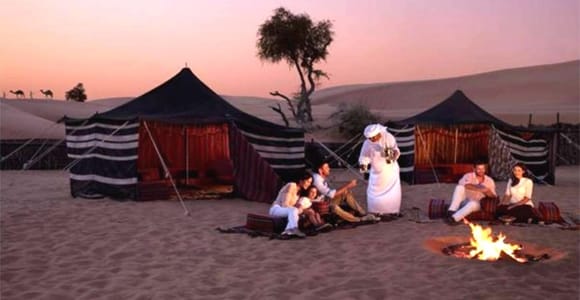
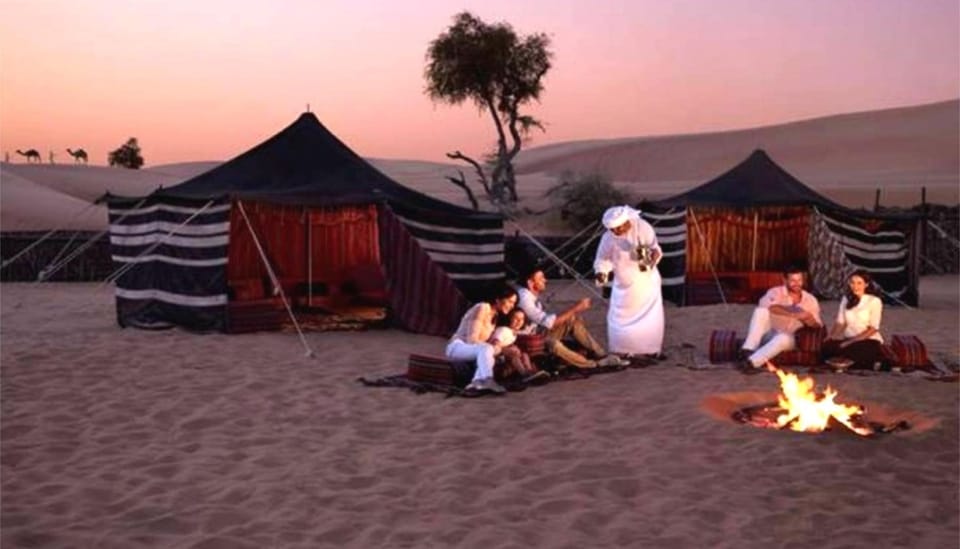
Look at the picture at the top of this page: striped tents, a fire, camels on a ridge of soft sand. Operators across the region use images like it, and it sets an expectation of dunes.
The desert immediately behind Sharm is not dunes. It is gravel plain, dark stone and bare mountain ridges, with sand in patches rather than seas of it. It is genuinely beautiful, and at dusk it is better than the photograph — but it is brown and hard rather than golden and soft, and people who arrive expecting the Sahara say so in their reviews. The sand-dune landscape is a long way from here; what is close is rock.
What is included — and the second column
The included list on the seven-hour trip is unusually long: hotel pickup and drop-off, air-conditioned transfer, a safari guide and an astronomer, helmet and goggles, the quad or buggy, the guided stargazing and telescope session, the camel ride, Bedouin tea and bread, a BBQ dinner from an open buffet, and water and soft drinks with the meal.
Three items come at the very end of that list, after the add-ons: shisha, photography services and oils. Those are exactly the things you are offered at the camp; check on the booking page which column they sit in, and expect to pay for them separately. The second column is always written more quietly than the first — read it anyway, before the camp reads it to you.
Bring cash regardless. The listing’s own what-to-bring list names it, alongside sunglasses, a sun hat, a camera and closed-toe shoes.
See the eight-hour Super Safari and its options
The other evening trips
The desert safaris category holds 28 trips from €12.09. Several of them build an evening rather than a ride; this is the one with the most detail on its booking page that this article works through.
| Trip | From | Rating | Reviews |
|---|---|---|---|
| Super safari: quad, camel, stargazing & BBQ dinner | €38.70 | 4.8 | 2,320 |
Other evening packages in the category combine the same pieces under similar titles — a 5-in-1 with quad, camel, dinner and stargazing; quad biking, camel ride and Bedouin dinner; ATV, camel, dinner, shows and stargazing. Their durations differ in ways the titles do not show you, so compare the hours as well as the price. Open each one before you choose. If you want the evening without a coach full of strangers, the private tours category starts at €7.47 and runs up a long way.
The camel, honestly
It is a photograph, not a journey. On these packages the camel ride is usually a short circuit around the camp, led by a handler, lasting minutes. Nobody is deceived exactly — “camel ride” is accurate — but people picture a crossing and get a lap.
If a real desert day is what you are after, that is a different trip entirely and it goes north: Dahab, the Blue Hole and the Coloured Canyon is ten hours of actual Sinai.
Take a jacket
This is the single most common thing people get wrong about the desert evening. The desert gives up its heat quickly once the sun goes, and there is nothing between the camp and the sky. From late autumn to spring the temperature drops hard after dark, and you will be sitting still on the ground for two hours at the end of it. In those months, a light jacket or a fleece, for everyone, including the people who insist they will not need it.
When we would not book it
If anyone in the group has back problems or is pregnant — the listing names both as not suitable, so this trip is not for them. If your children are very small: the trip is listed as not suitable under 3, it ends late, and a tired child two hours from bed in an open camp is nobody’s good evening. Older children are not drivers either: the listing says children aged 5–15 may take part only as passengers on a double quad with an adult, and a double quad has a combined weight limit of 150 kg. The alternatives are in Sharm El Sheikh with children.
And if the sky is what you came for, do not book it for the night of a full moon. Book the same trip four days later.