Snorkelling in Sharm for the first time: house reef, boat or national park
Updated September 26, 2026 · 7 min read
Sharm El Sheikh has 34 snorkelling trips in our catalogue, from €17.78, carrying nearly twenty thousand reviews between them. If you have never snorkelled before, none of that tells you the one thing you need to know first.
Here you do not walk into the sea. On most of this coast the shore is living coral, and walking across it would kill it, so you go out along a jetty or a floating pontoon and get in at the end. At Ras Um Sid, at the end of a small pier, there is a ladder where “you can easily enter the water, directly on the reef”. Snorkeling Report
Read that phrase again with beginner’s eyes. You climb down a ladder and the seabed is already not under your feet. There is no shallow bit to stand up in while you sort out your mask. That is not dangerous – it is why the reef here is as good as it is – but it is the opposite of the gentle sandy wade-in most people picture, and it is where first attempts go wrong.
Everything below follows from that one fact.
The three ways in, and who each suits
The hotel jetty. Free, five minutes from your towel, and you can stop the moment you have had enough – which is the real advantage, because a first attempt usually lasts four minutes, not forty. The catch is the drop-off. Do not make your first ever attempt off a jetty ladder in deep water with nobody beside you.
A boat trip. Counter-intuitively, this is often the easier start. You get a life jacket, an instructor and a ladder into open water with people watching. The most-booked full-day trip includes “life jackets for all participants” and states plainly:
Snorkeling experience is helpful but not required; instructors are available on board
The cost is that you cannot leave. A nine-hour boat is a long commitment for something you might discover you dislike.
The national park by road. The half-day trip to Ras Mohammed by bus runs 4 hours from €17.78 with 1,348 reviews – no crossing, no swell, and you are back by lunchtime. For anyone who is nervous about the boat as much as the water, this is the underrated option.
What the trips cost, and what the price is actually for
| Trip | Duration | From | Rating | Reviews |
|---|---|---|---|---|
| Ras Mohammed half-day by bus & Allah’s Gate | 4 hours | €17.78 | 4.7 | 1,348 |
| White Island and Ras Mohamed snorkelling trip | 6 hours | €24.63 | 4.7 | 3,811 |
| Ultimate Ras Mohamed & White Island with lunch | 9 hours | €25.65 | 4.8 | 3,898 |
| Ras Mohamed & White Island, snorkelling, diving & lunch | 8 hours | €36.00 | 4.9 | 1,642 |
Between the second row and the third, one euro and two cents buys you three more hours and a better lunch. Between the third and the fourth, ten euros buy a higher rating, one hour less, and an inclusions list that carries the national park fee without a caveat. None of it buys a better reef – it is the same park.
The equipment question, which decides more than the price
The single most expensive mistake a beginner makes here is assuming the mask is included. On the most-booked trip the inclusions read:
Snorkeling equipment (all options except Explorer Package)
and, on the same page:
National Park Entry Fees: 10 USD (all options except Explorer Package)
So the cheapest option on that page gives you neither. On the jeep day to Dahab one listing puts the gear under the inclusions while the fine print on the same page calls it “mandatory for safety” and rents it out on site for a fee.
A mask that leaks ruins a first attempt more reliably than cold water or waves. If you can, buy or borrow one before the trip and try it in the hotel pool: press it to your face without the strap and breathe in through your nose – it should hold on its own. That five-minute test is worth more than any amount of comparing listings.
See the eight-hour snorkelling and diving trip and its options
When the water is warm enough to stay in
| Month | Sea |
|---|---|
| February–March | 22°C |
| April–May | 23–25°C |
| June | 26°C |
| July–August | 28°C |
| September–October | 27°C |
| November–December | 25–26°C |
Sharm el Sheikh climate averages
Twenty-two degrees is swimmable and it is not warm. Floating still, face down, in a thin swimsuit, you lose heat much faster than you do swimming – and a beginner floats still, because they are concentrating. From December to April, ask whether a wetsuit is available and whether it is included, before you are on the boat.
Five things that make the first attempt work
- Practise breathing through the tube with your face out of the water first, standing on the jetty. The panic, when it comes, is about the breathing, not the depth.
- Wear the life jacket if one is offered, even if you swim well. It removes the question of staying up and leaves you only the question of looking down.
- Go in the morning. The wind builds during the day, and chop is what turns a first attempt into a mouthful of water.
- Do not clear your mask by taking it off in deep water. Get back to the ladder or the boat.
- Stop early. Four good minutes are a success. Twenty bad ones mean you never try again.
What not to do
Do not stand on the reef, ever – not to adjust a fin, not for a photograph. It is the whole reason for the jetties.
Do not book the nine-hour trip as your first attempt. If snorkelling turns out not to be for you, you have eight hours left on a boat.
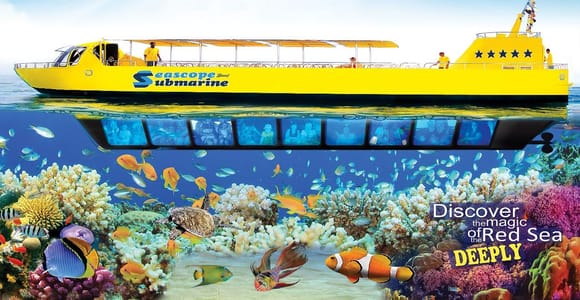
And if you already know the water is not going to happen, you can still see the reef: the semi-submarine has a glassed deck about three metres down and runs ninety minutes, and it is covered in Sharm El Sheikh with children, which is where most people find it. Once you are comfortable, the big day is Ras Mohammed and White Island, and the next step after that is under diving, from €22.50.